After-Hours Call Coverage for Home Health: Rules, Risks and How to Review Every Call
Federal rules don't require 24/7 phone staffing for Medicare home health, but duties like prompt condition-change alerts and complaint documentation don't stop at 5 p.m. How to cover and review after-hours calls.
Medicare-certified home health agencies are not federally required to staff phones 24/7 (hospices are), but the duties that matter most don't stop at 5 p.m.: you must promptly alert the practitioner to a change in a patient's condition and document every complaint and its resolution. Good after-hours coverage means a clear triage path, a written handoff for every call, and next-morning review of every after-hours call, not just the ones someone remembers.
General information, not legal advice. State licensure rules and payer contracts often add after-hours requirements; confirm yours.
Do home health agencies have to answer the phone 24/7?
Not under the federal Conditions of Participation. Hospice and home health differ:
| Hospice | Medicare-certified home health | |
|---|---|---|
| Federal 24/7 availability | Yes: nursing, physician services and drugs "routinely available on a 24-hour basis 7 days a week" (418.100(c)(2)) | No equivalent; administrator or designee and clinical manager available "during all operating hours" (484.105(b)) |
| Promptly alert practitioner to condition changes | Applies under hospice CoPs | Yes, 484.60(c) |
| Document complaints and resolution | Applies under hospice CoPs | Yes, 484.50(e) |
| Public weekend measure | Hospice Care Index: share of skilled nursing minutes on weekends (HCI technical report) | None directly |
Many states and payers do require 24/7 on-call for home health. Check both.
What goes wrong on after-hours calls?
- Non-clinical triage. An answering service operator decides what's urgent, and nobody reviews that decision.
- Verbal handoffs. The on-call nurse handles the call well, then relays it Monday in a hallway. The record shows nothing.
- No escalation path. Ask three on-call staff who they call when the physician doesn't answer. Three answers means no path.
- No count. Most agencies can't say how many calls came in last Saturday or what they were about.
- Complaints that never get logged. A frustrated family member at 9 p.m. is a complaint under 484.50(e), even if no one wrote it down.
How should a home health agency set up after-hours coverage?
- Write the triage rules down. Which statements (falls, chest pain, confusion, no-show) go straight to the on-call nurse, and which wait for morning.
- Use one escalation path: answering service, then on-call RN, then clinical manager, then physician, with phone numbers.
- Require a written handoff for every call (patient, reason, action taken, who was notified) by the start of the next business day.
- Review every after-hours call the next morning. Check that condition changes reached the practitioner and complaints were logged.
- Track volume and topics by hour and day, so staffing follows the calls.
Sampling vs reviewing every after-hours call
Weekday QA teams typically sample weekday calls. After-hours calls are fewer and higher-risk, which is the worst case for sampling: the one call that matters is the one least likely to be pulled. Reviewing every after-hours call is realistic when software does the first pass and the clinical manager reads only the flagged ones.
How SurfacerIQ helps
SurfacerIQ reviews every call, including after-hours and weekend calls, against the agency's own categories (falls, condition changes, complaints, missed visits). Flags route to a named owner, such as the clinical manager, as a ticket with the transcript excerpt, audio and resolution attached, and a time-of-day view shows when calls and signals cluster. SurfacerIQ reviews calls; it does not answer them or replace your answering service or on-call nurse. It is HIPAA-aligned and signs a BAA with every customer that may transmit PHI.
Who should choose which approach
- Low after-hours volume, strong on-call nurse: a written log plus next-morning manager review may be enough; make it a fixed routine.
- Answering service plus rotating on-call staff: add recorded calls and review of every call, because the triage decision is the risk.
- Hospice: 24/7 availability is a CoP and weekend care is publicly measured; treat after-hours call review as part of QAPI.
Frequently asked questions
Are home health agencies required to have 24-hour on-call?
Not under the federal home health CoPs, which require availability during operating hours. Many states and payer contracts do require it.
Are hospices required to be available 24/7?
Yes. 42 CFR 418.100(c)(2) requires nursing, physician services and drugs to be routinely available 24 hours a day, 7 days a week.
Does a weekend complaint have to be documented?
Yes. 484.50(e) requires agencies to document complaints and their resolution regardless of when they come in.
What should an after-hours call log include?
Patient, caller, time, reason, action taken, who was notified, and follow-up owner.
Can software answer our after-hours calls?
SurfacerIQ doesn't answer calls. It reviews calls your answering service and on-call staff handle and flags those that need follow-up.
Keep exploring
Related resources
Quality monitoring →
Move from 2% sampling to reviewing every conversation.
Call transcription →
Accurate transcripts feeding QA, coaching, and audit trails.
HIPAA at SurfacerIQ →
Compliance posture for regulated contact-center operations.
Related articles
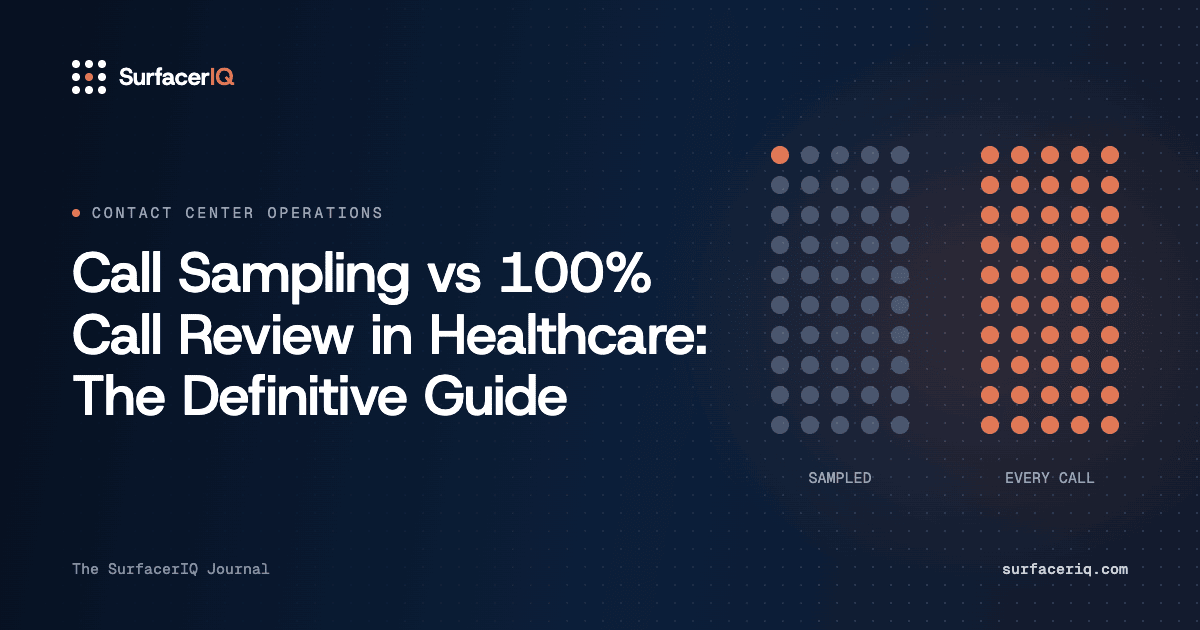
Call Sampling vs 100% Call Review in Healthcare: The Definitive Guide
Sampling 2-5% of calls measures average agent behavior; it misses rare, high-risk calls like falls and complaints. When sampling is enough, when healthcare needs 100% call review, and how to switch.
Every Number in This Blog Has a Link. That Was a Deliberate Choice.
How a statistic dies in home health marketing, the sourcing rules this library is written against, and a worked example where the verified source said the opposite of the convenient thing.
Building a Home Care QA Program When You Don't Have a QA Department
42 CFR 484.65 requires a program, not a department. The five artifacts a surveyor asks for, and how a small agency produces them without new headcount.
See SurfacerIQ in action
Calls in. Tickets out. Automatically. See how it works on a real call.