Call Sampling vs 100% Call Review in Healthcare: The Definitive Guide
Sampling 2-5% of calls measures average agent behavior; it misses rare, high-risk calls like falls and complaints. When sampling is enough, when healthcare needs 100% call review, and how to switch.
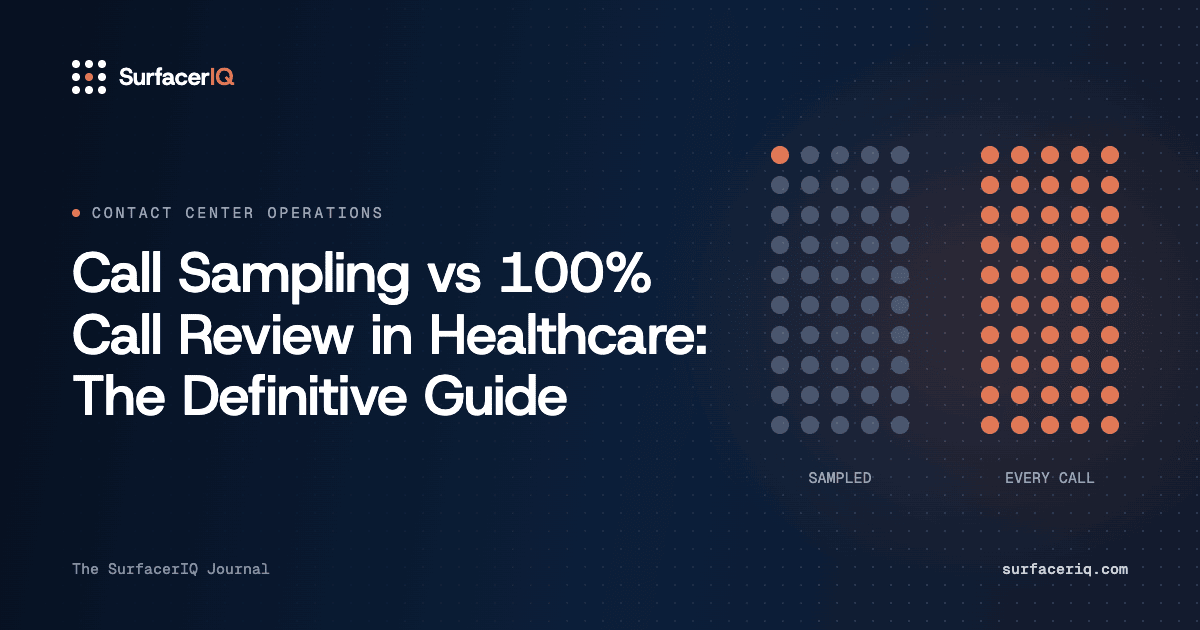
Call sampling (reviewing a few percent of calls) measures how agents usually perform; it is poor at finding rare, high-risk calls such as a reported fall, a complaint or a missed condition change, because those calls are unlikely to land in the sample. 100% call review, where software reviews every call and people review only what is flagged, is the better fit when the goal is catching safety and compliance events. Sampling is still fine for coaching on routine skills.
What's the difference?
| Call sampling | 100% call review | |
|---|---|---|
| Calls reviewed | A small share, often 1-5%, picked at random or by rule | Every call, first pass by software |
| Who reviews | QA analyst listens and scores | Software tags and scores every call; people review the flagged ones |
| Good for | Average agent behavior, coaching on routine skills | Rare events: falls, complaints, condition changes, churn language |
| Misses | Most rare events | Depends on how well categories are defined and tuned |
| Evidence for surveyors | Only for sampled calls | For any call |
| Staff time | Grows with calls reviewed | Grows with calls flagged |
Why sampling misses the calls that matter
Sampling estimates averages well. Rare events are a different problem. The chance a random sample contains at least one of a rare call type is 1 − (1 − p)ⁿ, where p is how often the event occurs and n is the number of calls sampled.
Illustrative example (not agency data): an agency takes 5,000 calls a month and 1 in 500 includes a reported fall (10 calls). A 2% sample is 100 calls. The chance that sample includes even one of those fall calls is 1 − 0.998¹⁰⁰ ≈ 18%. In about four months out of five, the QA team sees none of them.
Why this matters more in healthcare
- Safety. A fall mentioned on a scheduling call needs clinical follow-up; 484.60(c) requires home health agencies to promptly alert the practitioner to condition changes.
- Complaints. 484.50(e) requires agencies to investigate and document complaints and their resolution, whether or not the call was sampled.
- Surveys. A surveyor asks about a specific patient or complaint. A sampling program can only produce evidence for calls it happened to review.
- QAPI. 484.65 requires a data-driven quality program; call data from every call is a stronger input than a sample.
When sampling is still enough
- Very low call volume, where a person can actually listen to most calls.
- Coaching on routine skills (greeting, hold etiquette), where averages are what you want.
- Calibrating automated scoring: humans should still sample and score calls to check the software.
The objections, answered
- "Reviewing every call is impossible." It is for people. Software does the first pass; staff read only flagged calls.
- "The sample is statistically valid." For averages, yes. Not for finding the rare call that matters (see the math above).
- "AI isn't as good as a human reviewer." For nuanced coaching, humans still lead. Software's job is to surface which calls need a human, with evidence attached, and humans calibrate it.
How to move from sampling to 100% review
- Keep your current QA scorecard; run it on every call.
- Add safety and compliance categories: falls, complaints, condition changes, missed visits, churn language.
- Route each flag to a named owner with an expected response time.
- Keep a small human sample to calibrate automated scores.
- Report flags, owners and resolutions to QAPI monthly.
How SurfacerIQ does it
SurfacerIQ reviews every call against agency-defined scorecards and categories. Each score links to the moment in the transcript it came from, flags route to a named owner as tickets, and each signal keeps the transcript excerpt, timestamp, audio, agent, caller and resolution. Human QA stays in the loop for coaching and calibration. SurfacerIQ is HIPAA-aligned and signs a BAA with every customer that may transmit PHI.
Who should choose which
- Choose sampling alone if call volume is small enough to listen to nearly everything, or your only goal is routine coaching.
- Choose 100% review if calls carry patient-safety, complaint or compliance content (home health, hospice, home care, clinical intake), or you need evidence for any call a surveyor might ask about.
- Use both in most programs: software reviews every call; people sample to coach and calibrate.
Frequently asked questions
What percentage of calls do QA teams usually review?
Traditional QA programs commonly review a few percent of calls; SurfacerIQ's product page cites about 2%.
Is 100% call review required in healthcare?
No federal rule requires reviewing every call. But rules like 484.50(e) require documenting every complaint, and sampling can't show you complaints that weren't sampled.
Does 100% call review replace QA staff?
No. Software does the first pass; QA staff review flagged calls, coach, and calibrate the scoring.
Why does sampling miss rare events?
A small random sample is unlikely to include calls that occur rarely. With a 2% sample and an event in 1 in 500 calls at 5,000 calls a month, the chance of seeing even one is about 18%.
Is sampling ever the right choice?
Yes, for coaching on routine skills, very low call volumes, and calibrating automated scores.
Keep exploring
Related resources
Quality monitoring →
Move from 2% sampling to reviewing every conversation.
Call transcription →
Accurate transcripts feeding QA, coaching, and audit trails.
HIPAA at SurfacerIQ →
Compliance posture for regulated contact-center operations.
Related articles
Building a Home Care QA Program When You Don't Have a QA Department
42 CFR 484.65 requires a program, not a department. The five artifacts a surveyor asks for, and how a small agency produces them without new headcount.
After-Hours Call Coverage for Home Health: Rules, Risks and How to Review Every Call
Federal rules don't require 24/7 phone staffing for Medicare home health, but duties like prompt condition-change alerts and complaint documentation don't stop at 5 p.m. How to cover and review after-hours calls.
Every Number in This Blog Has a Link. That Was a Deliberate Choice.
How a statistic dies in home health marketing, the sourcing rules this library is written against, and a worked example where the verified source said the opposite of the convenient thing.
See SurfacerIQ in action
Calls in. Tickets out. Automatically. See how it works on a real call.